
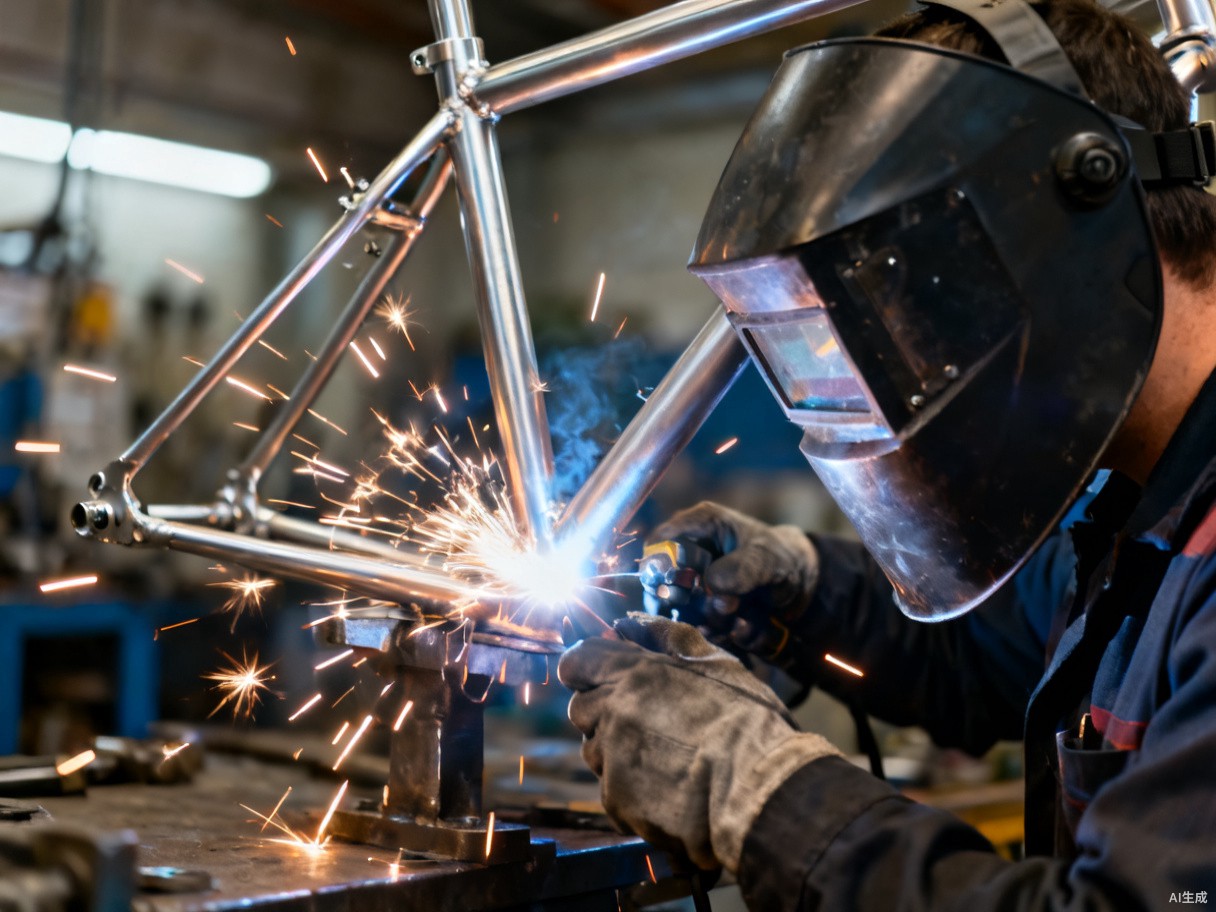
Aluminum and carbon fiber are the two dominant materials in mid- to high-end bicycle frames today. They differ in strength, weight, and ride feel — but the more important distinction is in how they are made. Aluminum depends on welding and heat treatment; carbon fiber depends on layup and curing. Understanding these process differences helps overseas buyers make the right material choice in OEM/ODM projects and evaluate supplier capability honestly.
1. Aluminum Frames: Welding Is the Core
A typical aluminum frame flows: tube cutting → welding → heat treatment → alignment → surface finishing. Welding is the variable that determines frame strength and fatigue life.
1.1 Mainstream Process: TIG Welding
Aluminum frames are almost always joined with TIG (GTAW) welding, for good reason:
- High weld quality, no spatter, clean bead appearance;
- Suitable for thin-wall tubes (0.8–2.0 mm);
- Controllable heat-affected zone, low distortion.
Premium frames use variable-polarity TIG (VP-TIG) to further reduce porosity and increase weld density.
1.2 Key Control Points
| Control Item | Standard Requirement | Impact |
|---|---|---|
| Pre-weld cleaning | Degrease + chemical clean, weld within 4 hours | Prevents porosity and oxide inclusions |
| Shielding gas | Pure argon or Ar+He mix, 8–15 L/min | Prevents oxidation/blackening |
| Welding current | 90–140 A (varies with wall thickness) | Too high burns through; too low leaves lack of fusion |
| Weld reinforcement | 0.5–1.5 mm | Excess reinforcement concentrates stress |
| Post-weld heat treatment | Solution + artificial aging (T6) | Restores strength; mandatory for 6061 |
1.3 Heat Treatment: T6 Is Non-negotiable
6-series aluminum (6061, 6063) loses roughly 30% of its strength after welding and must be restored via T6 heat treatment (530°C solution + 175°C artificial aging). An aluminum frame sold without T6 should not be on the road. Factory audits should verify furnace temperature records and aging time logs.
1.4 Common Defects
- Porosity: inadequate pre-cleaning or low gas flow;
- Lack of fusion: current too low or insufficient bevel gap;
- Undercut: wrong torch angle, erodes the parent metal;
- Hot cracking: mostly in 7-series alloys — use dedicated filler wire (ER5356 / ER4043).
2. Carbon Fiber Frames: Layup Determines Everything
Carbon frames are not welded. They are built from pre-impregnated fabric, molded, and cured at high temperature. The art is in layup design and cure parameters.
2.1 Manufacturing Flow
- Cutting: pre-preg fabric cut to design angles (0° / ±45° / 90°);
- Layup: layered on the mold with different weights and angles per zone;
- Pre-forming: insert bladder and inner mold to ensure uniform wall thickness;
- Curing: autoclave at 120–150°C for 60–90 minutes;
- De-mold and finishing: trim flash, sand surface;
- NDT: ultrasonic or X-ray inspection for internal voids and delamination.
2.2 Key Control Points
| Control Item | Standard Requirement | Impact |
|---|---|---|
| Layup angle | 0° load path, ±45° torsion, 90° impact | Wrong angle directly reduces stiffness |
| Cure temperature | 120–150°C, ±5°C tolerance | Under-cure leaves resin under-cross-linked |
| Cure pressure | 0.4–0.6 MPa (autoclave) | Low pressure causes voids and delamination |
| Resin content | 35%–42% by weight | Too high = brittle; too low = poor bond |
| Wall thickness tolerance | ±0.2 mm | Affects weight and stiffness consistency |
2.3 Common Defects
- Delamination: insufficient compaction during layup or low cure pressure;
- Voids: pre-preg out of freezer too long, moisture ingress;
- Wrinkles: poor layup handling, fiber direction deviates;
- Resin-rich zones: dead corners accumulate resin, weakening the area.
3. Aluminum vs. Carbon: Process Comparison
| Dimension | Aluminum Frame | Carbon Fiber Frame |
|---|---|---|
| Forming method | Welding + T6 heat treatment | Layup + autoclave cure |
| Labor per unit | 1.5–2.5 hours | 3–6 hours |
| Tooling cost | Low (universal fixtures) | High (dedicated mold per model) |
| Weight-to-stiffness | Medium | High |
| Consistency | Heavily dependent on welder skill | Excellent once process is locked |
| Time to mass production | 4–6 weeks | 10–16 weeks |
| Market position | Entry to mid-range | Mid-premium to top-tier |
4. Procurement Recommendations
- Certifications: prioritize factories with ISO 9001 and EN 14764/14766 test capability;
- Sample verification: for aluminum, request weld cross-section metallography; for carbon, request ultrasonic C-scan reports;
- Batch sampling: sample at least 3% per batch for fatigue (ISO 4210) and impact testing;
- Traceability: every frame should carry a unique serial that traces back to the welder / layup operator and heat-treat batch.
Hangdong International partners with factories running both aluminum and carbon lines. Every frame is factory-tested to ISO 4210 and supports OEM/ODM with customer-supplied geometry and decals. For factory audits or sample development, contact our sales team.